Cybercriminals are becoming more sophisticated every day!

Cybercriminals are becoming more sophisticated every day, targeting businesses of all sizes through fraudulent emails, fake purchase orders, spoofed domains, phone calls, and even text messages.

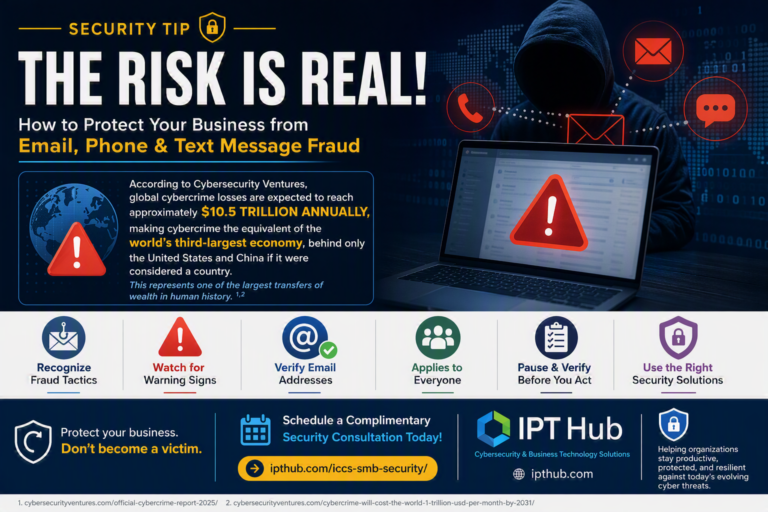
The Risk Is Real!

According to Cybersecurity Ventures, global cybercrime losses are expected to reach approximately $10.5 trillion annually, making cybercrime the equivalent of the world’s third-largest economy, behind only the United States and China if it were considered a country. This represents one of the largest transfers of wealth in human history.

Common Fraud Tactics

Fraudsters often impersonate legitimate companies, vendors, customers, executives, financial departments, or procurement teams in an attempt to:

  • Obtain sensitive information
  • Redirect payments
  • Change banking details
  • Trick organizations into shipping products
  • Steal credentials and login information
  • Install malware through links or attachments

Watch for These Warning Signs

  • Urgent requests requiring immediate action
  • Requests to bypass normal approval processes
  • Unexpected requests to change payment or banking information
  • Emails, texts, or phone calls requesting confidential data
  • Suspicious links or attachments
  • Sender addresses that look legitimate at first glance but contain slight variations

Example: Verify the Full Email Address

Always inspect the complete sender address, not just the display name.

Legitimate Example

john.doe@ipthub.com

Potentially Fraudulent Examples

  • doe@ipthubb.com
  • doe@ipt-hub.com
  • doe@ipthub-support.com
  • doe.ipthub@gmail.com

A single added, removed, or substituted character can be enough to deceive an unsuspecting recipient.

Remember: This Applies to Everyone

These scams are not limited to any specific company, vendor, customer, bank, technology provider, or institution.

Whether the communication arrives via:

  • Email
  • Phone call
  • SMS/Text message
  • Microsoft Teams
  • Social media
  • Messaging applications

Always verify suspicious requests using a trusted contact method that you already know is legitimate.

Before Taking Action, Ask Yourself

  • Am I expecting this request?
  • Does this follow our normal business process?
  • Is the sender’s domain legitimate?
  • Has the request been independently verified?
  • Is there unusual pressure, urgency, or secrecy?

If anything feels unusual, pause and verify before you act.

Check Point Harmony Workspace Recommendation

Modern attacks frequently target user identities, email accounts, cloud applications, and collaboration tools.

Check Point Harmony Workspace helps organizations protect Microsoft 365, Google Workspace, email, cloud storage, and user accounts by providing:

  • Advanced phishing protection
  • Account takeover prevention
  • Email threat detection
  • Cloud application security
  • AI-powered threat analysis
  • Continuous monitoring of suspicious activity

Protecting your users is no longer optional. It is an essential part of your cybersecurity strategy.

Schedule a Security Assessment

Want to understand how exposed your organization may be to phishing, business email compromise (BEC), ransomware, and account takeover attacks?

Closing Thought

Cybercriminals only need one successful email, phone call, or text message to create significant financial and operational damage.

Stay vigilant. Verify before you trust. Protect before you regret.

If you would like to learn how Check Point Harmony Workspace and other modern security solutions can help reduce your organization’s risk, our team would be happy to help you evaluate your environment and identify practical ways to strengthen your defenses.

Your security is our priority.