By IPTHUB Cyber Security Inc. — We Understand Cyber Security
Executive Summary
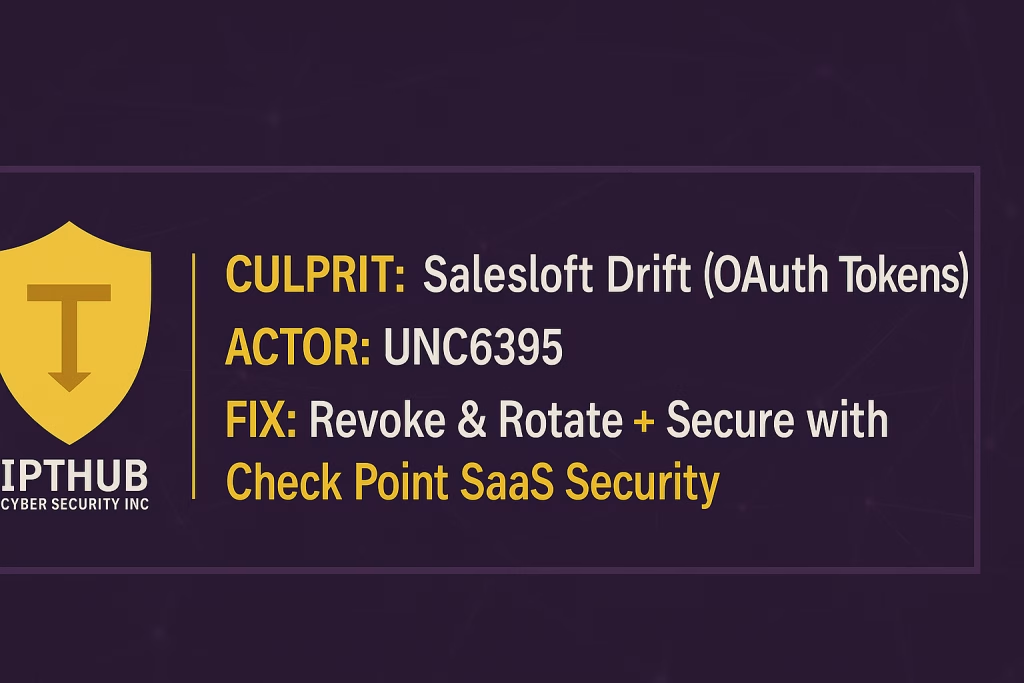
Multiple enterprises reported data theft from their Salesforce environments after attackers abused OAuth tokens from a third-party integration, Salesloft’s Drift application. This was not a flaw in Salesforce itself; the culprit is the Salesloft Drift integration, which attackers leveraged to run API queries and exfiltrate data. Google’s Threat Intelligence Group tracks the actor as UNC6395; several affected orgs (e.g., Cloudflare, Palo Alto Networks, Zscaler) have disclosed access to Salesforce support data via the compromised Drift tokens.
What Exactly Was Compromised? (Plain English)
- Attack path: OAuth tokens issued to Salesloft Drift → used to query Salesforce via normal APIs (no obvious login anomalies).
- Data types typically targeted: free-text support case content and credentials accidentally stored in cases or records (e.g., AWS keys, Snowflake tokens, plaintext passwords).
- Scope note: Cloudflare’s investigation found exposure limited to Salesforce Case objects between Aug 12–17, 2025.
Who’s Behind It?
Google attributes the campaign to UNC6395, a sophisticated actor focused on abusing OAuth-based SaaS integrations. (A separate claim by “ShinyHunters” also circulated in the press, but GTIG’s analysis centers on UNC6395.)
The Culprit — Clear and Simple
Culprit software: Salesloft’s Drift integration for Salesforce (the third-party connected app).
Not the culprit: Core Salesforce platform.
How to Check If You Were Affected (for teams that used Drift + Salesforce)
Look for these Indicators of Compromise (IOCs) in Salesforce Event Monitoring / API logs:
- Suspicious user-agents and integration behavior (scripted clients making bulk SOQL calls).
- Unusual SOQL queries hitting objects like User, Account, Case (e.g., mass counts, broad selects, high limits).
- Data exfiltration clues: look for queries that pull Case text and any fields with secrets (search for AKIA, password, token, snowsql, etc.).
- Operational tradecraft: large jobs or exports that are created and quickly deleted.
Immediate Remediation (Do This First)
- Revoke all OAuth/refresh tokens tied to Salesloft Drift; remove/disable the app if you don’t need it. (Salesloft/Salesforce also revoked Drift tokens and pulled the app from AppExchange.)
- Rotate credentials that might live in Salesforce (AWS keys, Snowflake tokens, app passwords).
- Audit logs for suspicious queries and bulk reads; preserve evidence and open a case with Salesforce if activity is unclear.
- Shorten session/token lifetimes and tighten connected-app policies (IP restrictions, least-privilege scopes).
Strengthening for the Future with Check Point (What IPTHUB Recommends)
Check Point has publicly highlighted that Drift/Salesforce demonstrates a blind spot in many SaaS stacks: SaaS-to-SaaS integrations using OAuth. Their guidance focuses on discovering integrations, monitoring token behavior, and detecting unusual data movement.
How Check Point SaaS Security (part of Harmony SASE) helps:
- SaaS Discovery & Shadow IT mapping: Automatically enumerate all SaaS apps, integrations, and tokens—so these “hidden” connections (like Drift → Salesforce) are visible.
- Integration Risk Assessment & Behavioral Analytics: Baseline normal OAuth activity per integration; alert or auto-contain when Drift-like tokens pull unusual data volumes, even if calls look legitimate.
- Data Movement Visibility & DLP: Track large exports and apply data-loss controls to sensitive objects. (Check Point documents DLP as part of its SaaS security approach.)
- SSPM + CASB posture hardening: Continuously check SaaS configs (SSPM) and enforce access controls (CASB/SSE) such as IP allowlists and reduced scopes.
Check Point’s blog on this incident summarizes the modern control set: real-time monitoring of SaaS-to-SaaS integrations, OAuth behavioral analytics, and data-movement visibility, delivered as Check Point SaaS Security within Harmony SASE.
Quick Checklist (Copy/Paste for your IT runbook)
Investigate
- Confirm whether Salesloft Drift was ever connected to your Salesforce.
- Pull Event Monitoring: search for broad SOQL on User/Account/Case and spikes in query volume.
- Hunt for secrets in Case text/custom fields (AKIA, password, token).
Contain
- Revoke Drift tokens; disable/remove the app.
- Rotate any exposed keys/passwords (AWS, Snowflake, app creds).
Harden
- Enforce least-privilege OAuth scopes and IP restrictions on connected apps.
- Shorten token lifetimes; require MFA where relevant for admins/integrations.
- Deploy Check Point SaaS Security (Harmony SASE) to discover integrations, baseline OAuth behavior, and detect abnormal data movement.
Sources & Further Reading
- Google Threat Intelligence: Widespread data theft targeting Salesforce via Salesloft Drift (UNC6395).
- Cloudflare post-mortem on Salesforce Case data exposure (Aug 12–17, 2025).
- Industry reporting on the token theft & exfiltration patterns.
- Check Point: The Drift–Salesforce Attack: Time to Rethink Your SaaS Security (Harmony SASE / SaaS Security controls).
- Check Point primers on SSPM vs CASB and DLP in SaaS environments.